
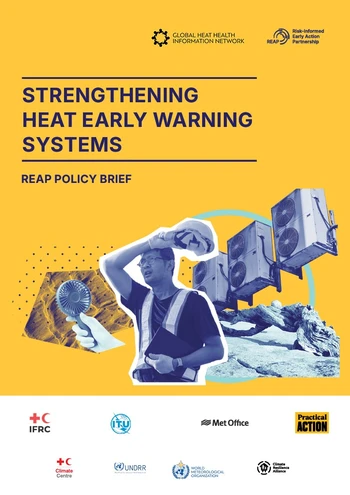
Strengthening heat early warning systems: REAP Policy Brief examines how Heat Early Warning Systems (HEWS) can be strengthened to better protect people, communities and essential services from the growing risks of extreme heat.
Extreme heat is becoming more frequent, intense, prolonged and widespread, with impacts across health, livelihoods, agriculture, education, infrastructure and essential services. While effective early warning can help reduce these impacts and enable action before and during heat events, the development of HEWS remains uneven. Warning systems vary considerably in how they assess risk, communicate impacts, reach communities and connect warnings to preparedness and action.
The policy brief highlights the importance of treating HEWS as end-to-end, people-centred systems that connect risk knowledge, forecasting and monitoring, warning communication, and preparedness and response. It also considers the need for stronger coordination across stakeholders and stronger governance. The brief also emphasises the importance of integrating heat within multi-hazard early warning systems, while recognising the distinct characteristics, vulnerabilities and response needs associated with extreme heat.
The policy brief was launched at the first Global Heat Forum, in the margins of Bangkok Climate Week in October 2026.
Funding
Funding for this project was provided by Zurich Climate Resilience Alliance and was overseen by the Red Cross Red Crescent Climate Centre, the Risk Informed Early Action Partnership (REAP) and Practical Action (as part of the Zurich Climate Resilience Alliance).
Contributing REAP Partners
- Global Heat Health Information Network (GHHIN)
- International Federation of Red Cross and Red Crescent Societies (IFRC)
- International Telecommunication Union (ITU)
- Practical Action
- Red Cross Red Crescent Climate Centre
- UK Met Office
- United Nations Office for Disaster Risk Reduction (UNDRR)
- World Meteorological Organization (WMO)
- Zurich Climate Resilience Alliance (ZCRA)
Suggested citation
REAP (2026). Strengthening heat early warning systems: REAP Policy Brief. Risk-informed Early Action Partnership (REAP) and Zurich Climate Resilience Alliance.