The Risk-informed Early Action Partnership brings together organisations that between them hold most of the working knowledge of how early warning systems function, from the setting of global technical standards through to the relationships that carry a warning into a household in the moment it matters.
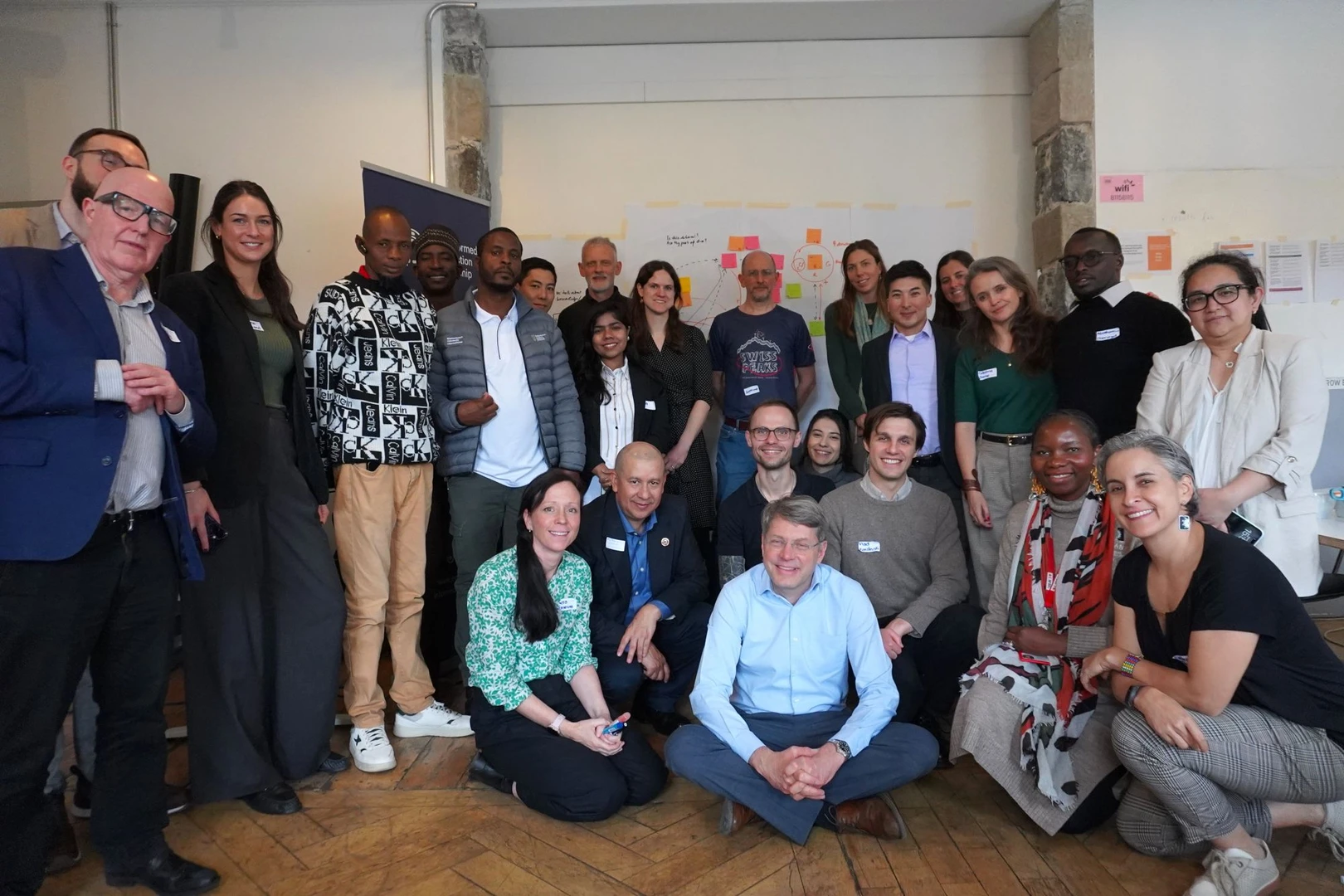
Earlier this year, a group of 28 REAP partners took the unusual step of examining not what each of them delivers, but how their contributions interact with one another as a single living system, and what that interaction produces for the communities the system exists to protect.
The initiative was convened and facilitated by Global Network of Civil Society Organisations for Disaster Reduction (GNDR) () with the support of the REAP Secretariat, and opened with a full-day participatory systems mapping workshop held in Geneva on 11 March 2026, during Humanitarian Networks and Partnerships Week.
Participants were drawn from across the span of the system: UN agencies and Early Warnings for All pillar leads including the WMO and the UNDRR; the IFRC and the Global Disaster Preparedness Center; donors and financing mechanisms; regional bodies, academia and the private sector through the GSMA; and civil society representatives who have led local and national early warning processes in countries including Kyrgyzstan, Colombia, Bangladesh, Kenya, Ghana, Peru, and Niger. Civil society, the constituency closest to at-risk communities, worked hand in hand with other key stakeholders of EW4All as parts of one ecosystem, which was itself an empowering moment for all participants and a departure from how conversations at the global level are usually composed.
“It was really impressive to see everyone working at the same level, … Like you will have the people working from the UN organisations at one side, the local civil society at another. But this time we were all working together, listening to each other, sharing the differences, sharing the experiences, the local and the global experiences. And that was amazing.” Carolina Garcia Londono, GNDR member Colombia
A different way of collaborating, at a moment when it matters
The work comes at a moment when the questions of trust, collaboration, and co-production through systems thinking approach are high on the agenda. The Early Warnings for All initiative has reached its midpoint, and while more than sixty per cent of countries now report having a multi-hazard early warning system, which represents genuine and hard-won progress, fewer than one third report having local plans to act on the warnings those systems produce. Coverage has grown considerably faster than the capacity to act upon it, and the initiative's own midpoint reflection points toward systems that are co-developed by all.
Across the early warning community there is broad agreement that translating warning into action requires people to be genuinely at the forefront. Trust, collaboration and local ownership are spoken about often, and what those words would mean in practice, as shared understanding and shared ways of working, is still being worked out.
Producing those conditions requires working across regional, national and local levels together, rather than through projects or at any one level in isolation. The field has generally approached early warning as a delivery chain, in which a forecast is produced, converted into a warning, and transmitted to those at risk. Collaboration has been largely organised along that chain.
Using systems thinking has provided a unique opportunity to look at the architecture of the systems and the relationship and connection infrastructure that sits underneath that chain, revealing which flows of information, trust, resources and authority are working, which have weakened or were never established, and where the partnership might create the greatest change in those flows.
The methodology drew on Donella Meadows' work on feedback loops and leverage points, the Participatory Systems Mapping approach developed by the Centre for the Evaluation of Complexity Across the Nexus (CECAN), and the living systems framework of Fritjof Capra and Pier Luigi Luisi, which holds that the health of a system is determined by the quality of the connections and feedback between its levels rather than by hierarchy among them. To our knowledge, this is the first time this framework has been applied to the early warning sector in this way, and the partners involved approached it as a generative lens held lightly rather than as established doctrine, with disagreement treated throughout as valuable data about the system itself.
What became visible when we looked together
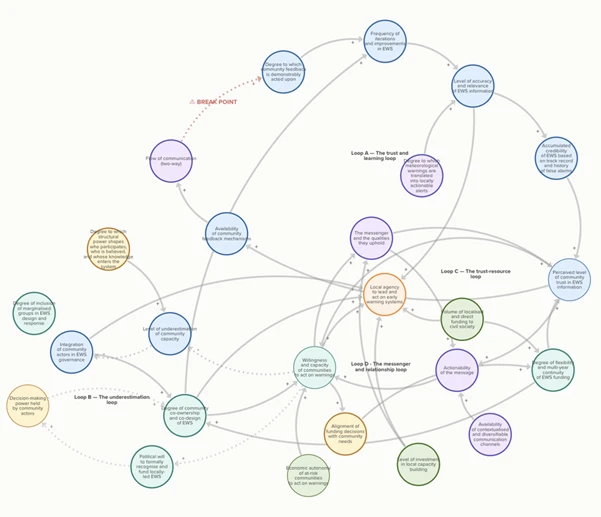
In pairs, participants first explored across the system how connections work in the community of practice, and instances where it works. Then we identified the factors relating to the flows of trust, information, resources and authority that influence the focal factor: the agency of local communities and actors to lead and act on early warning. Afterwards, this focal factor was placed at the centre of the map, and we started tracing the causal connections running toward it.
In the aftermath of the workshop, and based on the analysis of all the conversations and ideas, the results were summarised into one report that described the process and the feedback loops identified, including the leverage points.
The feedback loops carry a recognisable story:
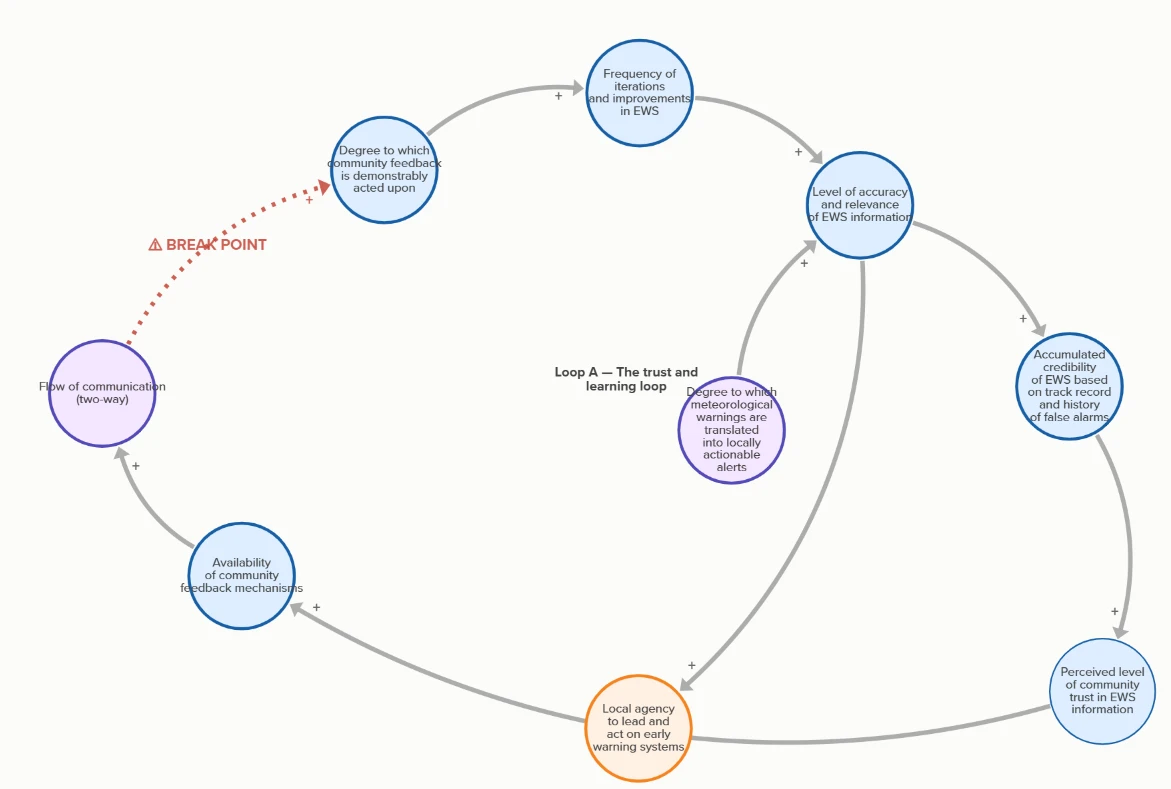
- The first concerns trust and learning, and represents the system's core capacity to improve itself. When communities trust a warning they act on it and they offer feedback on what happened, and where that feedback reaches the institutions responsible, warnings become more accurate and more relevant, credibility accumulates, and trust grows further. This loop turns on a single hinge, which is whether community feedback is demonstrably acted upon, and the mapping suggested that in most contexts this hinge is where the loop stalls.
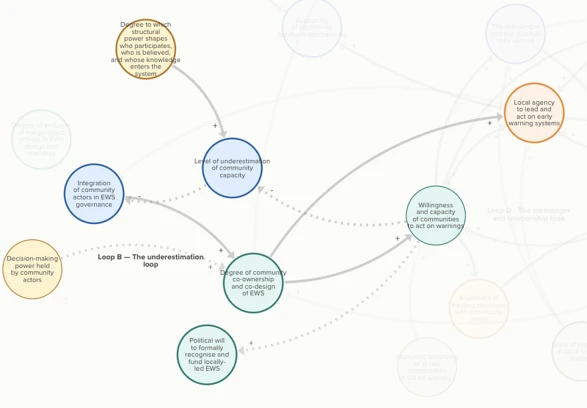
- The second loop describes the underestimation of local capacity, and it currently runs against the system's own intentions. Where governance, funding and design processes have been built around an assumption that communities receive warnings rather than shape them, communities are absent from design, and their absence means they have little opportunity to demonstrate what they would have contributed. The resulting shortcomings tend to be attributed to local incapacity rather than to the absence of co-design, which confirms the original assumption and closes the loop again. What makes this pattern significant is that no single actor is responsible for it, which is precisely why it has proved so persistent.
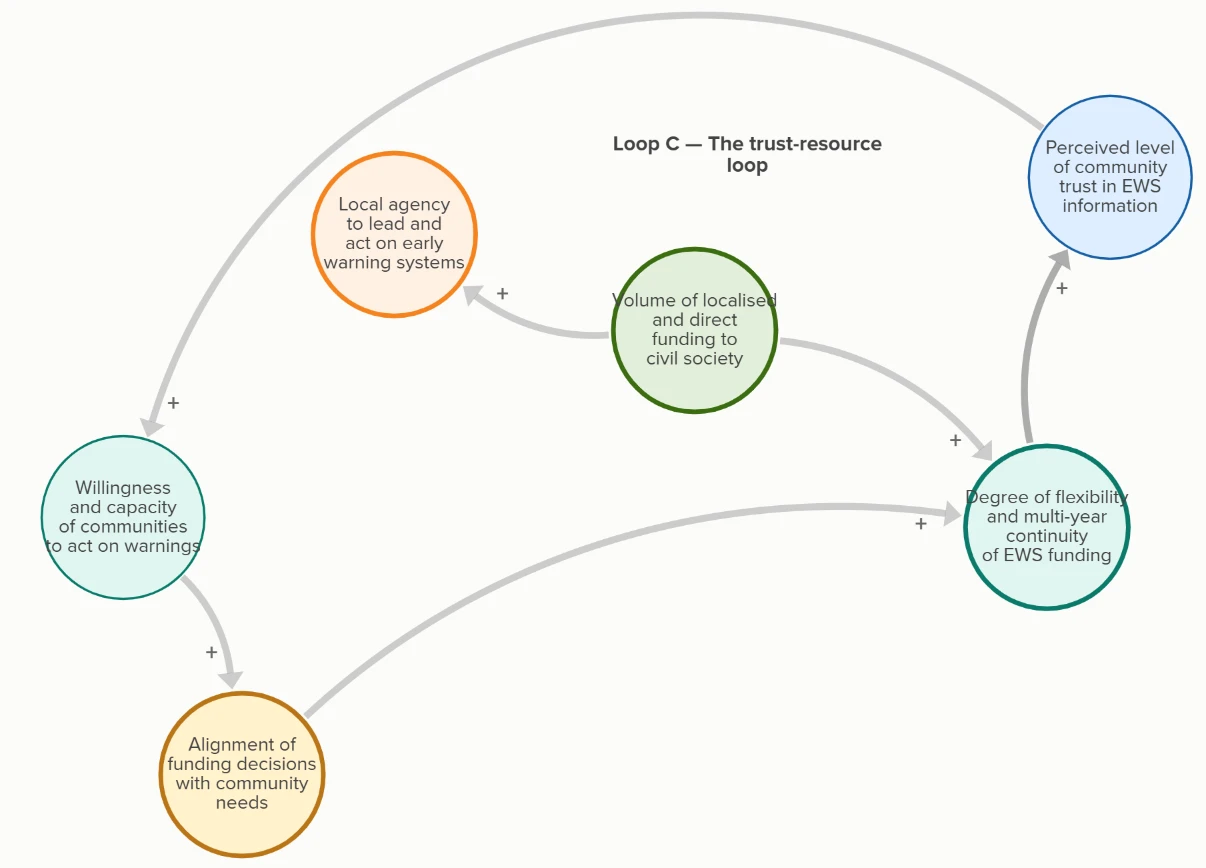
- The third loop connects funding and trust. Building trust requires sustained presence over time, and financing frequently determines whether that time is available. Where funding rewards relational work and remains in place long enough, trust deepens and demonstrated value follows. Where funding is tied to coverage metrics on cycles shorter than the timescales over which trust is built, it can quietly erode the relationships it is intended to support. The mapping suggested that funding modality functions as a trust variable within this system, and not solely as a resource variable.
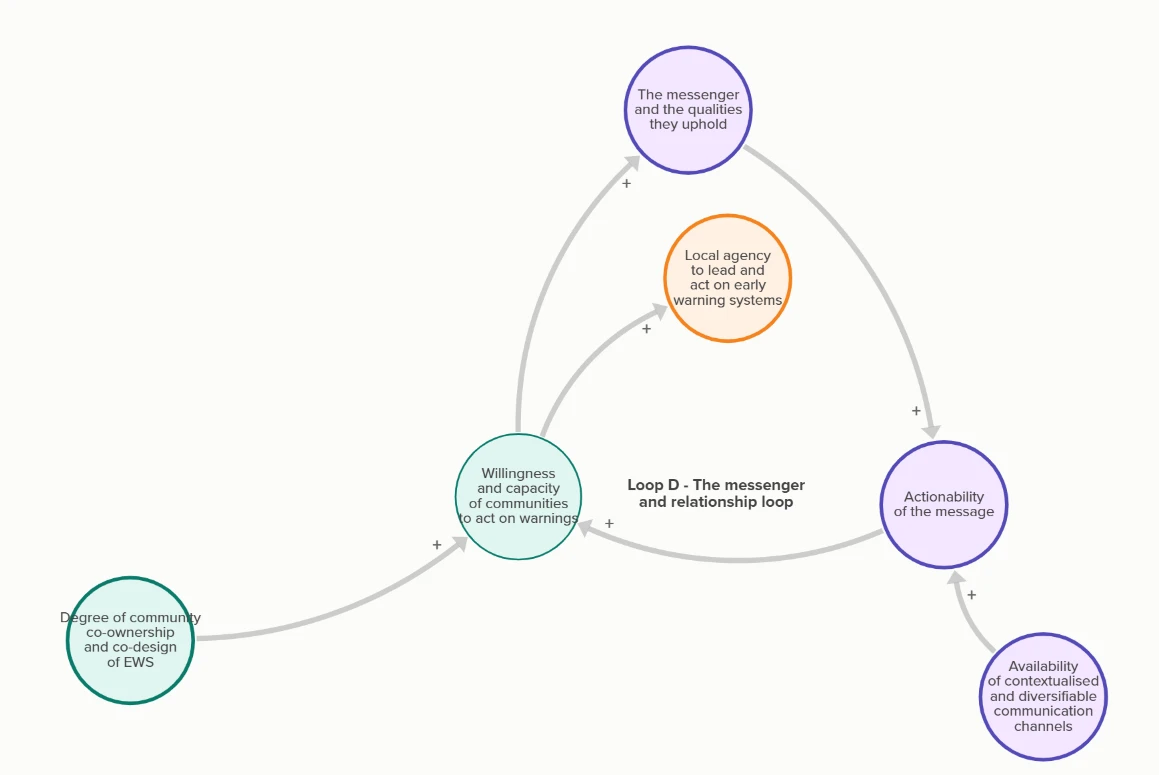
- The fourth loop is the one already working well. In context after context, warnings reach people and prompt protective action because a trusted mayor or an elder, community volunteer, a local civil society organisation, a Red Cross National society coordinator has built and maintained a genuine relationship over time, and that relationship, alongside the technical quality of the product, is what moves people to act. The difficulty is that this work is slow, depends heavily on individuals, and remains largely invisible in project design, monitoring frameworks and funding decisions. The element of the system that functions most reliably is among the least formally recognised.
Reading the four loops together, we identified where collective effort might begin and what becomes possible to propose within institutional processes. Establishing the structural connections through which community experience can travel back into decisions taken at national, regional and global level would dramatically improve the system's ability to learn. Recognising, resourcing and sustaining the relationships that already make warnings actionable would strengthen what is demonstrably working rather than building alongside it. The fuller findings, including the complete map and the leverage points, are set out in the summary report.
Where we are now and what we are learning
The March workshop opened the initiative and over the following months the material the group produced was analysed and put into working hypotheses, and the map was digitised in a digital mapping platform, Kumu, so that it could continue to evolve.
Original participants reconvened online on 28 May to validate and challenge the emerging findings, and on 10 June the initiative was opened to the wider partnership through a webinar attended by approximately sixty people from around forty organisations. Online consultations have continued since, and the map has already grown to incorporate factors that participants raised once they had a first version to respond to. It remains a shared object belonging to the partnership, and it is intended to keep changing.
“What this process has shown is that the knowledge and capacity needed to make early warning work already exist across the partnership; our task now is to connect them more deliberately, listen to what communities and local actors are telling us, and turn that shared learning into collective action.” – Catalina Jaime, Head of REAP Secretariat.
One observation from the process deserves particular note. Participants who see this system from entirely different vantage points, from global standard-setting through to community practice, independently identified the same connection points and the same absences. That degree of convergence, arrived at from such different positions, suggests these patterns are structural features of how the system is currently organised rather than the reflection of any single perspective.
The initiative also produced a lesson about its own design that has shaped what comes next. A map developed by one organisation on behalf of a partnership generates genuine interest, and interest is a different matter from ownership, which grows from participation in the process of making rather than from receiving what has been made. This is the map's own central finding applied to itself, and it points clearly toward a more collaborative approach in the next phase.
Going regional and the courage to partner differently
The clearest opportunity now is to take this approach to the regional level, where the connections between global architecture and national and local practice are most actively negotiated, and where regional bodies already convene the actors who would need to be in the room. Early warning systems in a given region share hazard profiles, institutional arrangements, funding patterns and histories of trust that a global map can only describe in general terms, and a regional mapping process would allow partners to trace their own loops with the specificity required to act on them.
GNDR and the REAP Secretariat would welcome conversations with regional bodies, national governments and a broad range of stakeholders and partners interested in convening such a process, designed jointly from the outset rather than delivered to participants.
Furthermore, what systems practice asks of a partnership at this stage is the courage to start building future-looking and unusual partnerships that have the potential to change the architecture of the system.
The loops described above are properties of the architecture rather than of any one component within it. Shifting them requires partners to identify the leverage points where a change in one place would travel through the whole, and to form the partnerships capable of acting on them. Those partnerships will often be unusual ones. Partners who can locate their own work within one of the loops are warmly encouraged to consider who they would need alongside them to move it, including those they would not ordinarily approach, and to get in touch if that conversation would be useful.
A map on its own is only a picture. What gives it meaning is partners willing to look at the system together, to reach beyond the familiar boundaries of projects and mandates, and to stay with the work long enough for different patterns to take hold.
The summary report and the interactive Kumu map are both available.
If you want to learn more about barriers to localising EWS, please find the Strategic Roadmap here.
For further information or to discuss a regional mapping process, contact vera.exnerova@gndr.org.